Thomas von der Trave
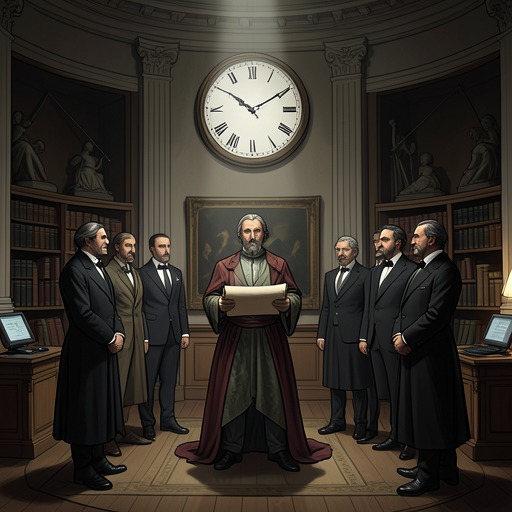
The Glass Bead GameThomas von der Trave is the Magister Ludi whose authority shapes several decisive transitions in Joseph Knecht’s life: he tests the young player, recommends his admission to the Order, and entrusts him with successive missions at Mariafels. Famous and cosmopolitan, gracious in public yet uncompromising in guarding the Glass Bead Game, he joins meticulous artistic judgment to the calculated courtesy of institutional leadership. His career also stands at a hinge between the Game’s secular ideal and its increasingly consequential relationship with religious institutions.
Identity and Stewardship
As Magister Ludi, Thomas von der Trave is both the public representative of the Glass Bead Game and its vigilant guardian against contamination. He is widely traveled and cosmopolitan, gracious and obliging toward those who approach him, yet severe to the point of fanaticism in protecting the Game. The contrast between his courteous manner and strict standards defines his authority: civility does not mean permissiveness, and his warmth in receiving people does not soften his insistence on the discipline of the art.
His public image is misleadingly cool. Observers describe him as an icy rationalist, with a merely distant civility toward the arts; younger, ardent amateurs sometimes judge him disparagingly because he is not an enthusiast and tends to avoid grand, exciting themes in the great public Games. But the brilliance of his constructions and their unequalled form reveal to connoisseurs that he understands the subtlest problems in the Game’s world. His excellence lies less in conspicuous fervor than in exacting command of form.
The larger cultural status of the Game helps explain what his office protects. By this period, the Game has become an intellectual and artistic synthesis, partly assuming the place of art and speculative philosophy; Christian theological language can enter its symbolic system alongside mathematical axioms and music. Yet Thomas insists on maintaining its distinct character. In his view, the Game is neither philosophy nor religion but an art sui generis, and turning it into a vehicle for theological philosophizing would confuse its proper tools and purpose. His stewardship thus involves guarding a boundary even as the Game absorbs materials from many traditions.
The Examination of Knecht
Thomas first summons Knecht to his home in everyday clothes and asks him to come for a half-hour each day over the next few days. The work appears at first to concern inferior memoranda whose shortcomings are obvious. Knecht initially wonders why the Magister is spending time on such material, then recognizes that the assignment serves a second purpose: Thomas is courteously but stringently examining him. The seemingly minor task becomes a test of critical judgment, patience, and professional readiness.
The meetings continue daily for two weeks. Knecht notices that associates have begun treating him more shyly and with an ironic respect, and senses that something consequential is approaching. Thomas ends the sessions without ceremony, thanks him for his valuable collaboration, and tells him that he should apply for admission to the Order. The heads of the Order have already been informed, and Thomas expects no difficulty. In the same conversation, however, he offers a warning about the intellectual temptation he sees in gifted young players: Knecht, like many of them, may be inclined to use the Game as an instrument for philosophizing. Thomas argues that philosophy should be pursued with philosophy’s own legitimate tools, and that the Game must not be made into a substitute theology.
His warning lands amid Knecht’s excitement at realizing that his student freedom is ending. The recommendation is not an abstract endorsement: Knecht goes directly to the Order’s secretariat at Waldzell and finds his name already on the list of nominees. He requests that the Music Master perform the admission ceremony and travels to Monteport. Thomas’s examination therefore both recognizes Knecht’s ability and initiates his passage into service, while reminding him that advancement brings obligations and boundaries as well as honor.
From Admission to Mission
Thomas’s next conversation with Knecht makes the change in status explicit. When Knecht speaks of taking leave for “a while,” Thomas points out that he is still thinking in student terms. In the Order, even the highest officeholders may obtain study leave, but they must specify its duration; Thomas cites his predecessor and teacher, who secured a full year in the London Archives, as an example. The anecdote turns an administrative point into a lesson in precision: a member of the hierarchy must make his commitments definite.
Thomas then explains why he needs Knecht. The Benedictine monastery of Mariafels, an old center of learning friendly to Castalia and supportive of the Glass Bead Game, has requested a young teacher for an extended stay. The emissary is to offer introductory courses and encourage the monastery’s few advanced players. Thomas has discreetly tested Knecht for this assignment, and his selection has accelerated Knecht’s entry into the Order. What appeared to be an examination of scholarly competence was also preparation for a service role beyond Waldzell.
After Knecht returns from an initial period of work at Mariafels, Thomas sets out the larger political purpose behind a second mission. The Board has considered establishing a permanent Castalian representative at the Holy See. Thomas argues that Castalia and Rome, both charged with preserving spiritual life and the cause of peace, cannot remain almost strangers, particularly when future dangers may give them common enemies and a shared fate. He acknowledges the unequal age and standing of the two institutions: Castalia, the younger power, should be prepared to accept second place and give Rome precedence. The proposal is cautious rather than triumphalist, an effort to build an alliance without provoking a rebuff.
Knecht is to return to Mariafels, continue his studies, teach a modest course in the Game, and gradually win Father Jacobus’s support for the plans in Rome. Thomas emphasizes patience: the mission may take a year, two years, or longer, and must not appear impatient or overeager. Knecht accepts, but frankly raises the personal cost. He is a Glass Bead Game player and has already spent two years away from Game studies because of his first mission; another prolonged absence may leave him still further behind. Thomas’s plan therefore makes the tension between an individual’s craft and the Order’s demands concrete. Knecht’s acknowledged talent is precisely why he is asked to subordinate its cultivation to institutional service.
Political Courtesy and Institutional Legacy
Thomas’s policy rests on a reading of changing historical circumstances. The Roman Church has survived the great epoch of wars and emerged renewed, while secular centers of art and science collapsed amid cultural decline; the Order and the Castalian ideal arose from those ruins. In Thomas’s account, the Church’s longevity and proven resilience make it the senior partner, while future crises make rapprochement prudent as well as dignified. His diplomacy does not erase the difference between the institutions. It seeks to make that difference governable through deference, gradual persuasion, and reciprocal understanding.
The narrative later describes the elaborate courtesy practiced by the leaders of the hierarchy. The more divisive the question, the more polished and strict the courtesies exchanged, a ceremonial form that restrains passion and shields the participants behind the dignity of office. Thomas is remembered as a particularly admired master of this art. Knecht does not simply imitate him: his own style is less pointed and less ironic, more indebted to Chinese courtesy. Yet Knecht, too, is regarded among his colleagues as unsurpassed in courtesy. Thomas’s influence thus belongs not only to the assignments he gives but also to the institutional language through which disagreement and authority are managed.
His diplomacy at Mariafels bears fruit through Knecht’s sustained exchange with Father Jacobus. Jacobus remains distrustful of Castalia’s claim to spiritual seriousness even after he has begun to understand it, but his study of its history and the Game eventually makes him one of its most influential friends outside the Province. The work of the two men contributes to benevolent neutrality, scholarly exchange, occasional cooperation, and ultimately concord between Rome and Castalia. Thomas’s plan does not produce an instant conversion or erase Jacobus’s reservations; its success takes the form of a durable relationship between institutions, built through instruction and continued argument.
Thomas is also linked to the ritual life of the Game he safeguards. The annual solemn Game gathers Castalia’s differing tendencies into symbolic harmony, restrains competition among disciplines, and recalls their unity. For believers it has the force of consecration; for unbelievers it can serve as a substitute for religion. That sacred reach sharpens the importance of Thomas’s insistence on the Game’s distinct artistic nature: he protects an institution whose practice can approach worship without claiming to create its own theology.
Place in Knecht’s Development
Thomas represents a turning point in Knecht’s successive awakenings. Knecht later recalls that he entered the Order at Thomas’s command, after choosing the Game and Waldzell, and subsequently accepted the office of Magister Ludi. Each decision once seemed a step along a straight road toward truth; later he understands these stages as places to pass through and transcend. Thomas is therefore part of both Knecht’s ascent within Castalia and the chain of commitments from which Knecht eventually moves away.
That retrospective does not reduce Thomas to an obstacle. He recognizes Knecht’s promise, prepares him for responsibility, and entrusts him with work whose long-term consequences extend beyond the Game’s immediate community. At the same time, the very process by which Knecht becomes useful to the hierarchy helps reveal the limits of a life confined to office and specialization. Thomas’s role is consequently double: he is a capable mentor and administrator whose careful diplomacy serves Castalia, and the representative of an order of service that Knecht ultimately has to transcend.